
Heater Guide · Sizing
How Many Heaters Do You Actually Need? The Sizing Math We Run
Every under-warmed event traces back to the same arithmetic mistake: heaters sized to square footage instead of to people, wind and humidity. Our fleet is deliberately simple — the 50,000 BTU mushroom and the 55,000 BTU glass-tube pyramid, both at a flat $130 per heater, per event day — so the entire sizing question becomes how many of each, placed where. This is the worksheet our crews run on every Charleston quote.
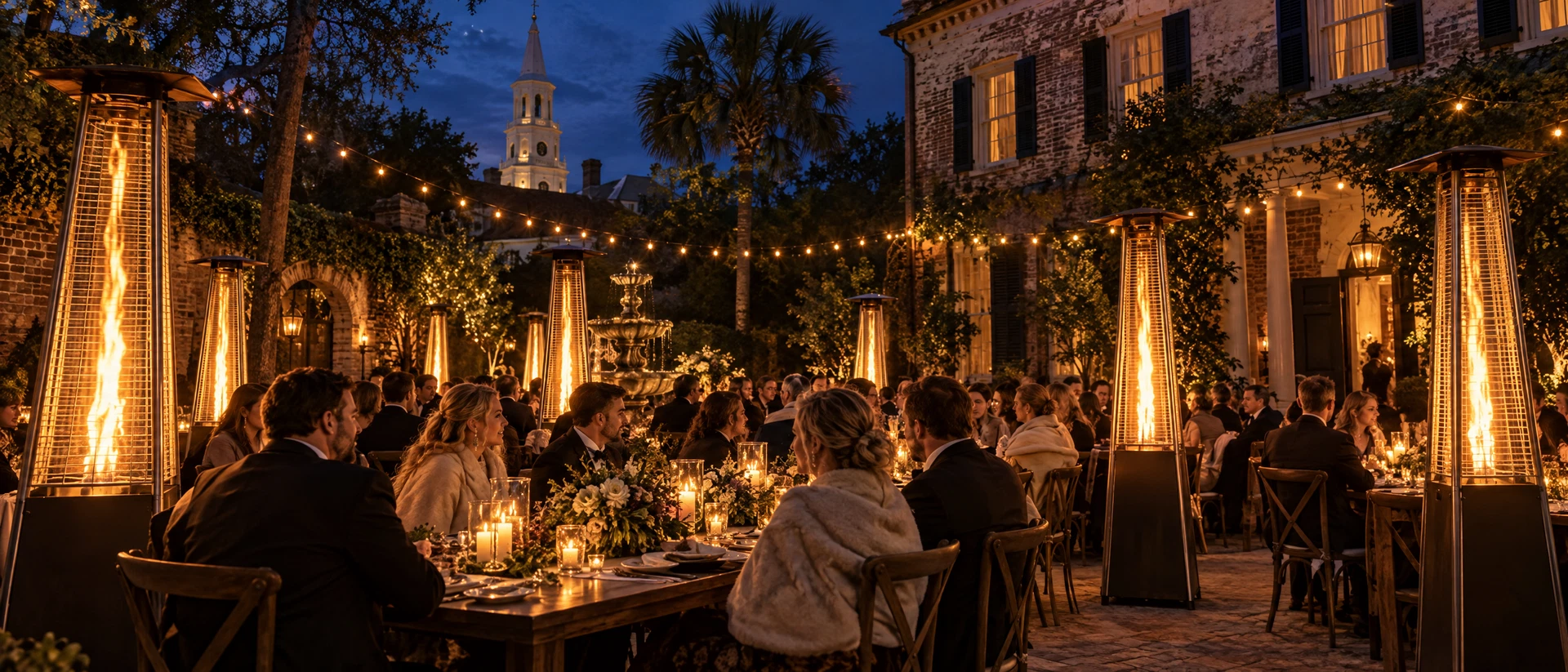
Step 1 — Count people clusters, not property
Outdoor heating is radiant zone heating. There is no "average patio temperature." You are building warm islands where bodies sit, then spacing them so guests cross warmth on every route they take. Count three things first: seated guests at tables, standing clusters (cocktail zones, buffet lines, dance-floor edges), and the paths guests walk between them.
With a focused fleet the rule is clean: one 50k mushroom per 8-ft round table seating eight to ten, or per 100–150 square feet of mingling space. One 55k pyramid per six to eight seated guests in an ambience zone, or one every 8–10 feet along an aisle, entrance or parapet where the glow matters more than raw BTU.
- 8-ft round banquet table (8–10 guests): 1 mushroom centered beside it
- Mingling zone: 1 mushroom per 100–150 sq ft
- Aisle or entrance row: pyramids every 8–10 ft on center
- Cocktail cluster (6–8 standing): 1 pyramid or 1 mushroom
- Dance-floor edges and dark corners: +1 mushroom per corner
Step 2 — Apply the Charleston wind multiplier
Coastal humidity changes how cold reads: at 48°F and 80% humidity, damp air steals heat from skin faster than the thermometer admits, so plan the rise, not the number. Then apply the one rule that decides everything — sustained wind above 10 mph strips the warm-air boundary layer off skin and effectively halves radiant coverage. A sheltered walled courtyard runs at 1.0× base count; marsh-adjacent lawns, bridge-front sites and beach venues run at 1.5×.
That multiplier is applied to the count, not bought with bigger flames: the units are fixed-output. Pair heaters on the windward edge, back them against walls, hedges and tent panels, and let guests sit downwind of the machinery. In December through February evening events we add one unit per zone regardless, because a cold review costs more than a heater.
- Sheltered courtyard, calm night: ×1.0 base count
- Marsh, bridge or beach exposure: ×1.5 base count
- Sustained gusts past 15 mph: re-architect seating behind windbreaks
- Dec–Feb evening events: +1 unit per zone, always
Step 3 — Mix the four rentals by job
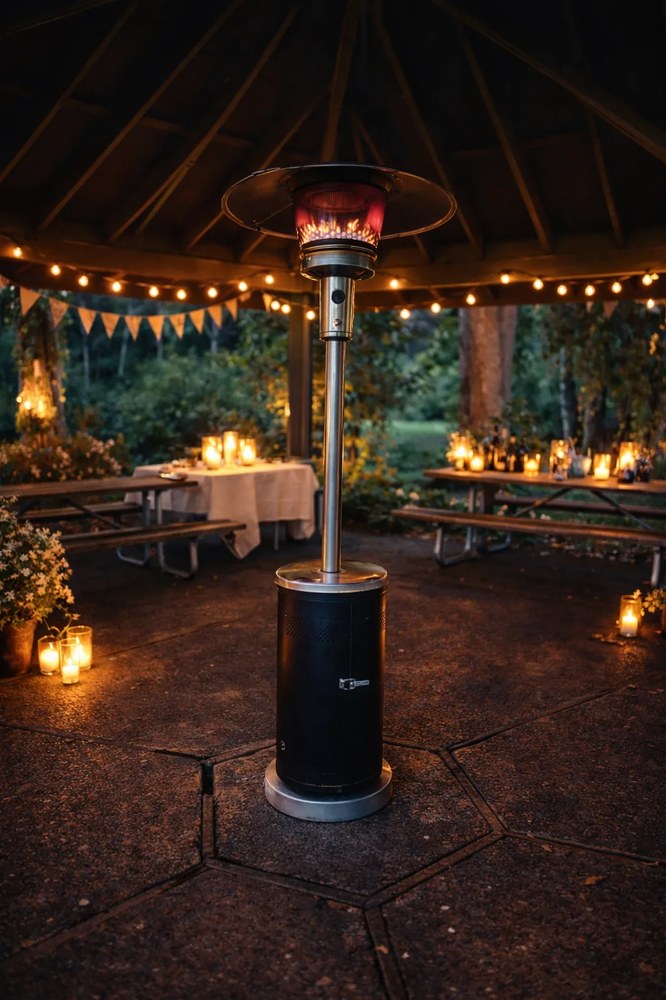
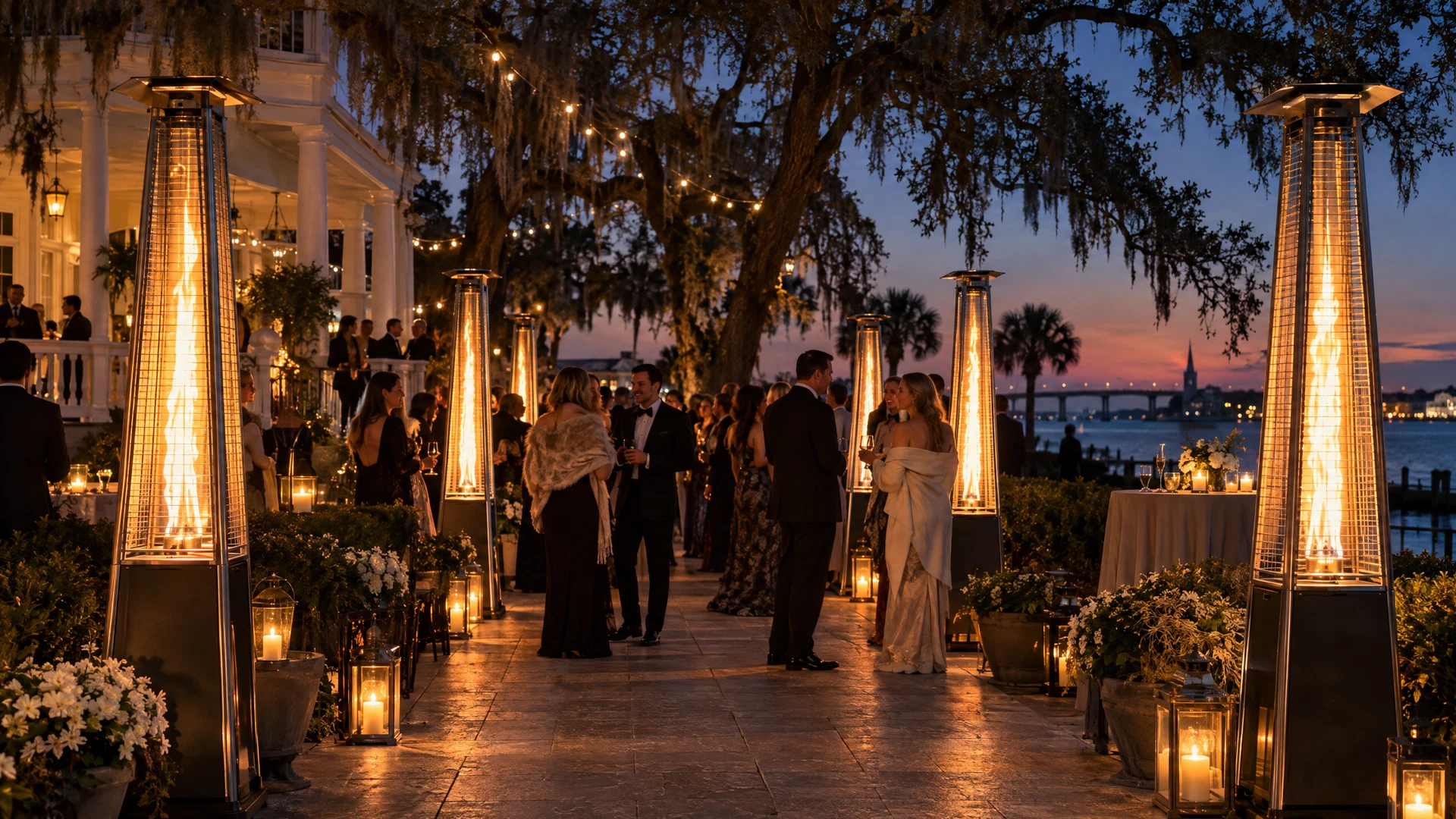
Mushrooms and pyramids are not interchangeable and the best plans stop pretending they are. The mushroom's dome banks more radiant heat into a seated group, so it owns dining tables, long mingling floors and any zone where comfort is graded by whether people stay seated. The pyramid's enclosed flame holds steady in breeze, radiates sideways through the glass, and is photographed like a lighting fixture — so it owns ceremony aisles, entrance pairs, gala parapets and cocktail vignettes.
A typical winter wedding splits roughly 70/30: mushrooms over every table cluster, pyramids lining the aisle and fronting the entrance. A market or festival flips the logic toward mushrooms along browse aisles, with pyramids marking the gates. When torn between counts and finishes, spend the budget on warmth first — every finish is the same $130 per heater, per event day anyway.
Step 4 — Runtime and tank planning
A 20-lb propane tank carries about 430,000 usable BTU. Against the mushroom's 50,000 BTU/hr burn that is roughly 9 hours; against the pyramid's 55,000 it is about 8 hours. Propane is billed per filled tank used, so a six-hour evening event fits one tank per heater with margin, and your fuel line stays predictable.
Swaps become a planning question past ten hours — all-day markets, galas with late sets, brunch services with early doors. The arithmetic: one filled 20-lb tank per heater per event up to ten hours, plus one spare tank for every three heaters on longer runs, and our crew changes them during the event so no zone dips cold. Dimming mid-event (medium burns 13–16 hours) stretches every tank further.
- Mushroom: ~9 hrs per 20-lb tank at 50k high
- Pyramid: ~8 hrs per 20-lb tank at 55k high
- ≤10 hr events: one filled tank per heater
- >10 hr events: +1 spare tank per 3 heaters, swapped mid-event
Worked example: 120-guest Charleston winter wedding
Fifteen 8-ft rounds in a walled garden (120 guests), a marsh-edge ceremony lawn with 10-foot aisle rows, cocktail hour on an open terrace, forecast 46°F with a light breeze. Receiving the wind multiplier as a gift — the garden is courtyard-sheltered at 1.0× — the count starts at one mushroom per table: 15. The cocktail terrace is 500 sq ft of mingling: 4 more mushrooms at 125 sq ft each. The ceremony aisle takes 6 pyramids per side-line at 9 ft centers, plus 2 flanking the garden entrance.
Total: 19 mushrooms and 8 pyramids — 27 heaters, each at the same $130 event-day rate, with 27 filled tanks plus a nine-tank spare pool for a 12-hour day that comfortably covers the 11- and 12-hour runtimes with one scheduled swap. If the same plan sat on a bridge-front lawn, the 1.5× wind factor would push the mushroom count to about 29 with paired windward placement — which is exactly why we ask about wind before we ask about guest count.
The placement pass that makes the count work
A correctly sized fleet in wrong positions still loses. Three rules we enforce on every install: heaters sit downwind of seating, not upwind, because a unit placed in the weather's path blows its own warmth away; every guest stays in line of sight of a reflector or glowing tube, because radiant heat does not bend around walls, columns or bar counters; and coverage circles overlap by roughly two feet so nobody stands in a cold seam.
Send us your dimensions, guest count, venue exposure and date. The quote comes back with a marked-up placement plan — mushrooms on dots, pyramid rows on lines, the tank schedule underneath — and you approve it before anything loads.
Sizing constants cheat sheet
| Mushroom table rule | 1 per 8-ft round seating 8–10 guests |
|---|---|
| Mushroom mingling rule | 1 per 100–150 sq ft of standing zone |
| Pyramid role | Aisle, entrance and cocktail rows at ~10 ft comfort diameter |
| Pyramid row spacing | 8–10 ft on center for overlapping warmth |
| Sheltered courtyard factor | ×1.0 base count |
| Marsh / bridge / beach factor | ×1.5 base count |
| 20-lb tank energy | ≈430,000 usable BTU |
| Mushroom runtime | ≈9 hrs at 50k high (~0.44 gal/hr) |
| Pyramid runtime | ≈12 hrs at 55k high |
| Spare tank rule | +1 per 3 heaters on events past 10 hours |
| Overlap rule | Comfort circles should overlap ~2 ft — no cold seams |
| Rate | $130 per heater, per event day; propane per filled tank used |
Mushroom vs pyramid: the two lines you are sizing
| Sizing factor | 50k mushroom | 55k glass-tube pyramid |
|---|---|---|
| Heat output | 50,000 BTU/hr | 55,000 BTU/hr |
| Comfort zone | 10–12 ft diameter | ~10 ft diameter |
| Guests per unit | 8–10 seated, or 100–150 sq ft | 6–8 seated or a standing vignette |
| Layout pattern | One per table cluster / zone | Rows at 8–10 ft spacing on aisles & entrances |
| Runtime per 20-lb tank | ~9 hrs high | ~8 hrs high |
| Wind behavior | Open dome loses warmth over 10 mph | Tube shields flame; holds output steadier |
| Finishes | Stainless, bronze, black | Stainless and black; bronze on request |
| Best job | Warm the seats | Warm the frame |
Best for
- Weddings sizing table heat vs aisle glow
- Festival producers planning browse-aisle coverage
- Restaurants counting units per recovered seat
- Anyone comparing 1.0× courtyard vs 1.5× coast sites
Watch out
- Square-footage-only math under-counts spread-out guest clusters
- The ×1.5 wind factor is a count rule — output per unit is fixed
- Ten-hour-plus events need spare tanks scheduled, not improvised
- A pyramid row cannot rescue an uncovered dining table
From the math to the order
Send us your dimensions — get the count back free
Tell us your date, layout and guest count — the placement plan and quote come back the same business day.
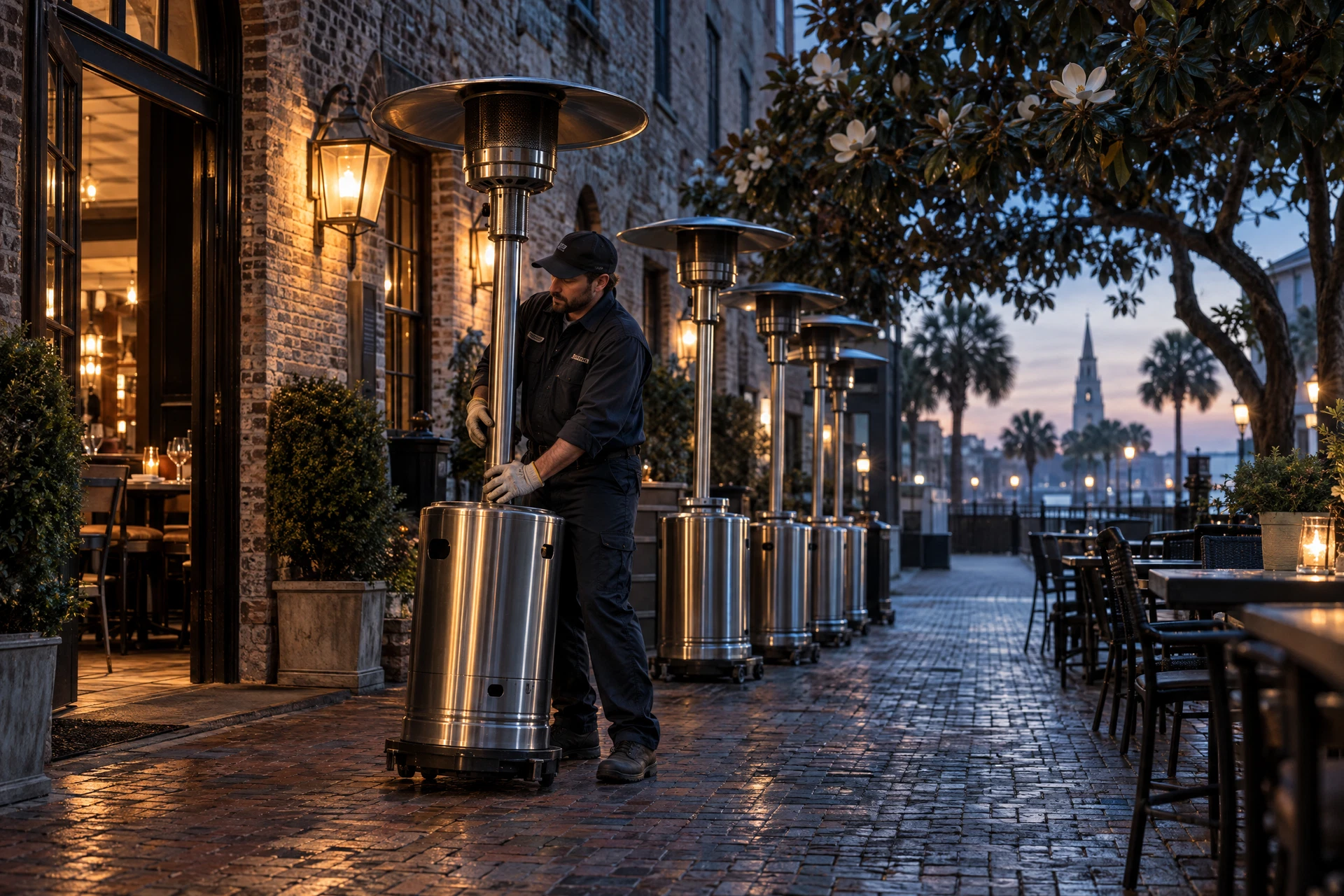
Sizing decisions made visible
Frequently asked questions
Is a 50,000 BTU heater enough for my patio?
For a seating group of eight to ten under low wind, yes — its comfort diameter is about 10–12 feet. For a whole patio of mingling guests, treat it as 100–150 square feet per unit and multiply the count for wind exposure. Send your dimensions and we will return a marked-up placement plan at no charge.
How many heaters for 120 wedding guests?
With fifteen 8-ft rounds in a sheltered garden: roughly 19 mushrooms — one per table plus cocktail-terrace coverage — and 6 to 8 pyramids for the aisle and entrance. On a marsh or bridge-front site the same plan multiplies the mushroom count by 1.5. Our worked example above walks through both versions line by line.
How much propane will the event actually use?
One filled 20-lb tank per heater covers any event under ten hours — the mushroom runs about 9 hours and the pyramid about 12. Past ten hours, add roughly one spare tank per three heaters and we swap them mid-event. Propane is billed per filled tank used, so you pay only for what burns.
Why does my heater stop feeling warm at the beach end of the event?
It is almost always wind, not the unit. Past 10–12 mph, gusts keep stripping the warm-air layer off your skin faster than radiant heat restores it. The fixes are placement, not power: move seating downwind of a wall or hedge, pair units on the exposed edge, and multiply the count by 1.5 on marsh, bridge and beach sites.
Is pricing still $130 no matter which heaters I mix?
Yes. The rate is a flat $130 per heater per event day; propane is billed per filled tank used. Mushrooms, tabletops, pyramids and pits price identically in every finish, so the right answer is always the layout — mix as many zones and styles as the plan calls for and the arithmetic stays the same.
The math that got a five-star review
“I sent a napkin sketch of the courtyard and they sent back a placement diagram with fourteen dots. Executed exactly that. The wind factor call they made was the difference for our head table.”
“We budgeted six heaters for the market. Holy City talked us into nine with wind pairing on the north aisle. Zero complaints about cold that year, and we've booked them for three more markets.”