
Heaters for Corporate Events: Rooftops, Retreats and Launch Nights
Corporate events in Charleston fail on warmth in a specific way: the room is fine, but the good view is outside and nobody stays there. We heat the zones people actually stand in — rooftop rails, courtyard cocktails, launch patios, retreat lawns — with a unit count you can defend to a facilities manager.
Check heater availability in 30 seconds
Our Heater Collection
Every unit we keep in the Charleston fleet, organized by rental type and shown in every color we stock. Rent any of them at a flat $130 per heater, per event day; propane billed per filled tank used.
Mushroom Heater Rentals
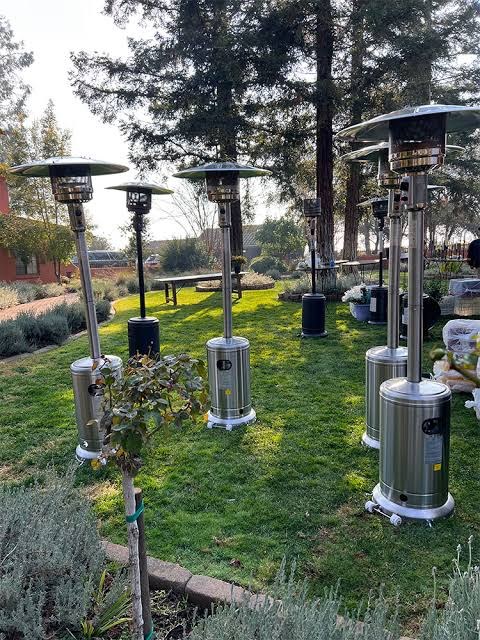
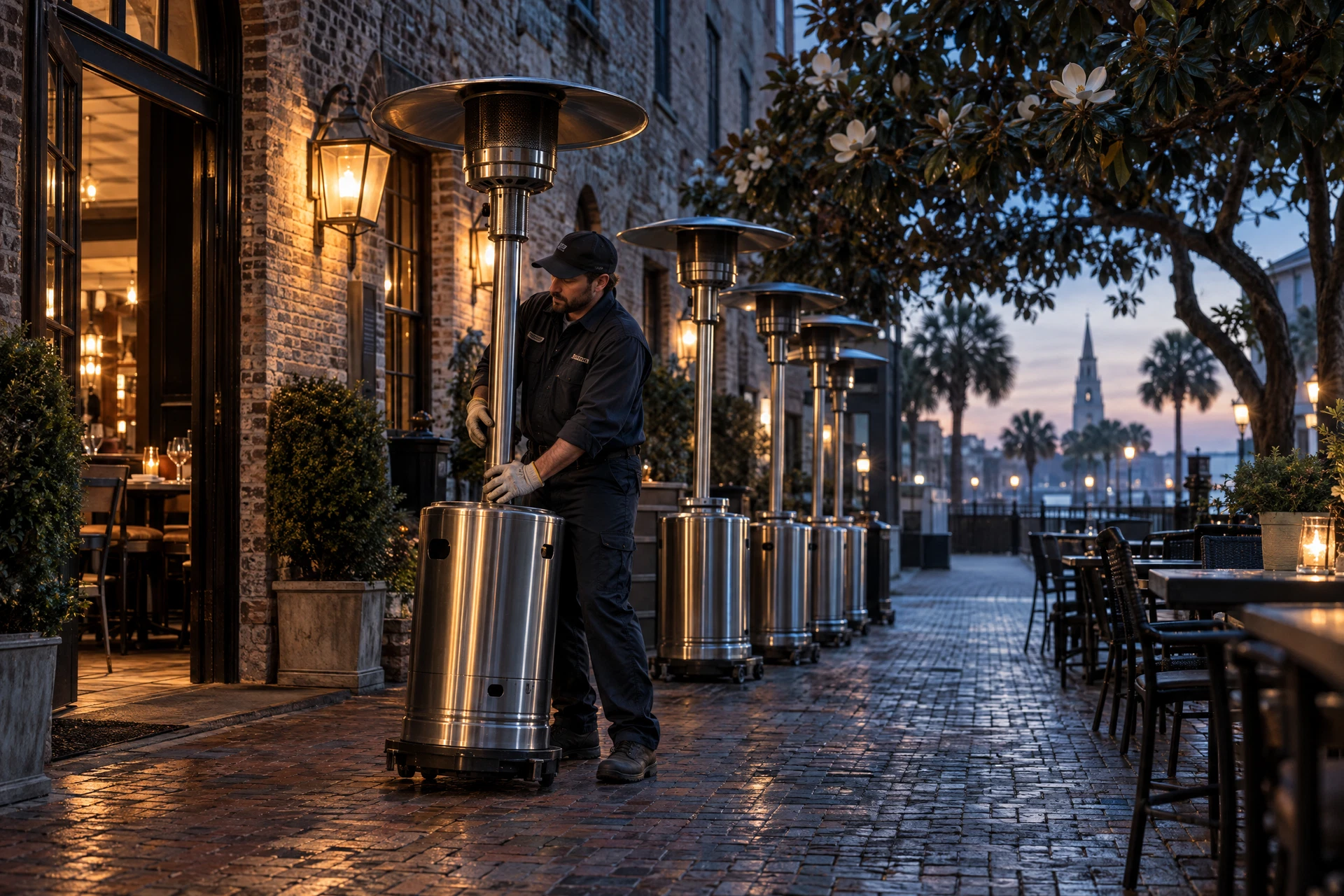
The workhorses. A wide dome banks radiant warmth over dining tables, festival rows and bar crowds, and one filled tank runs most of a night.
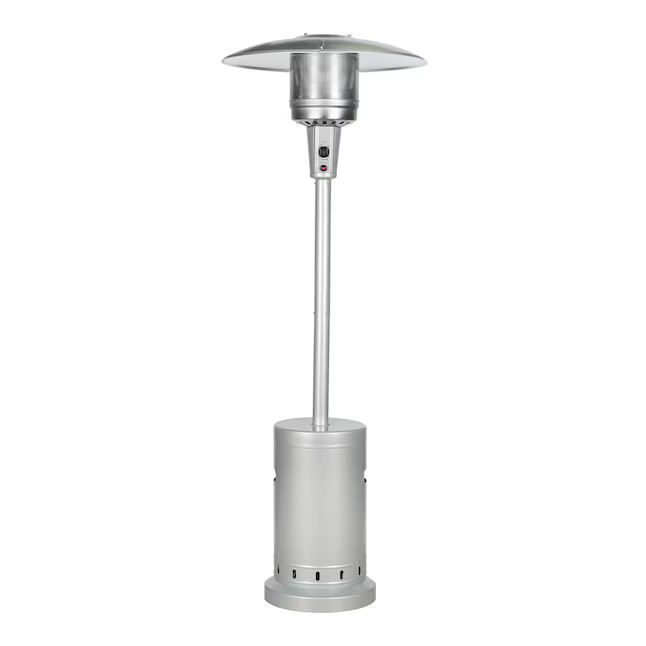
Silver Mushroom Heater
- Stainless Steel
$130 per event day + propane per filled tank
Rent This Model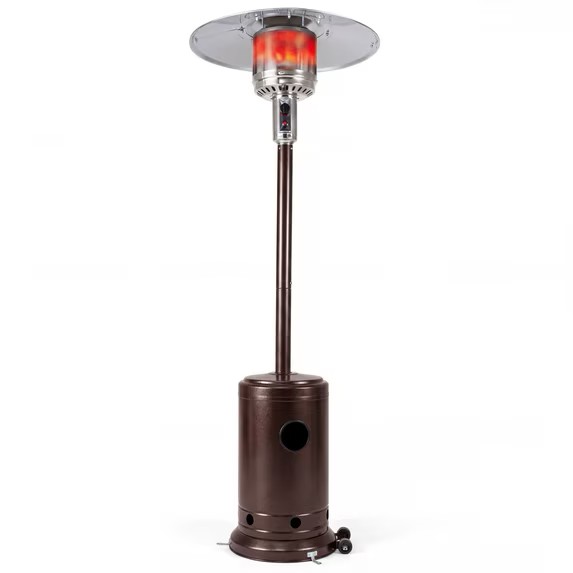
Bronze Mushroom Heater
- Bronze
$130 per event day + propane per filled tank
Rent This Model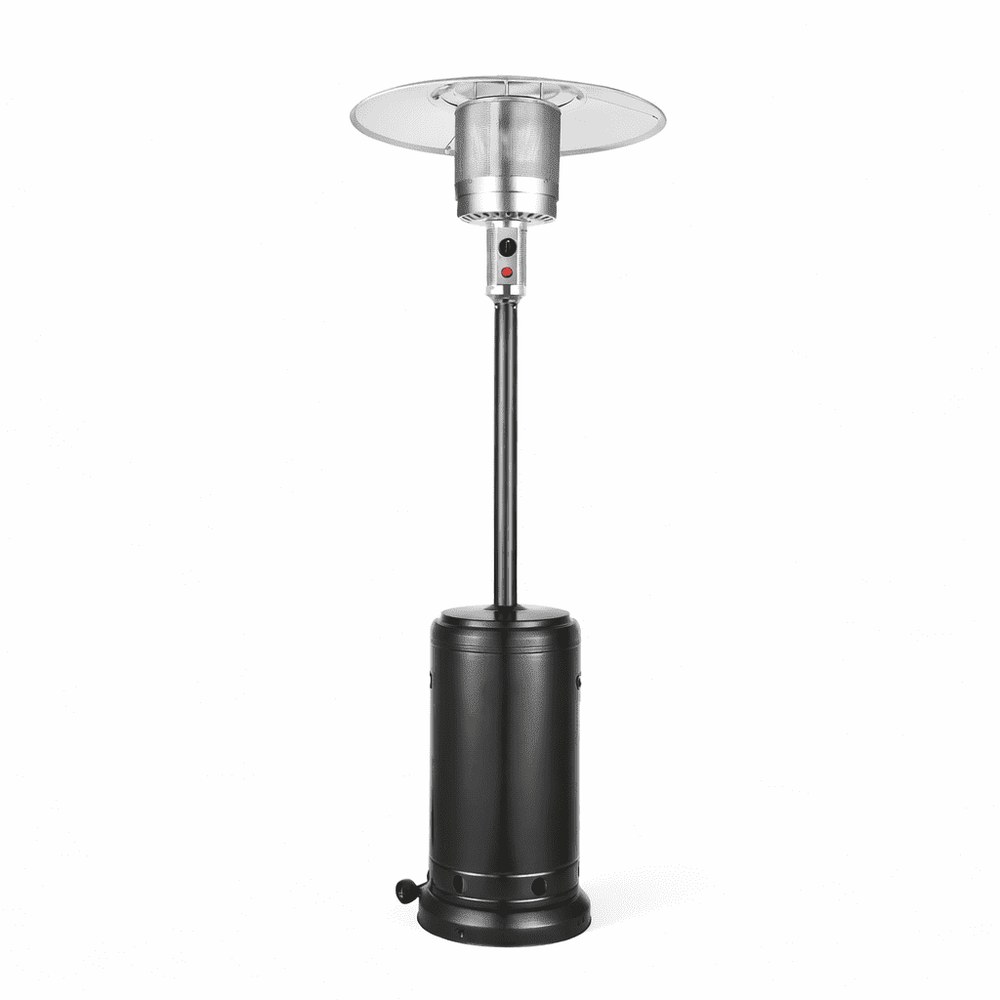
Black Mushroom Heater
- Matte Black
$130 per event day + propane per filled tank
Rent This ModelTabletop Heater Rentals
The small units that ride the bar rail, the buffet and the gift or card table — warmth on the surfaces a 90-inch column can’t reach.
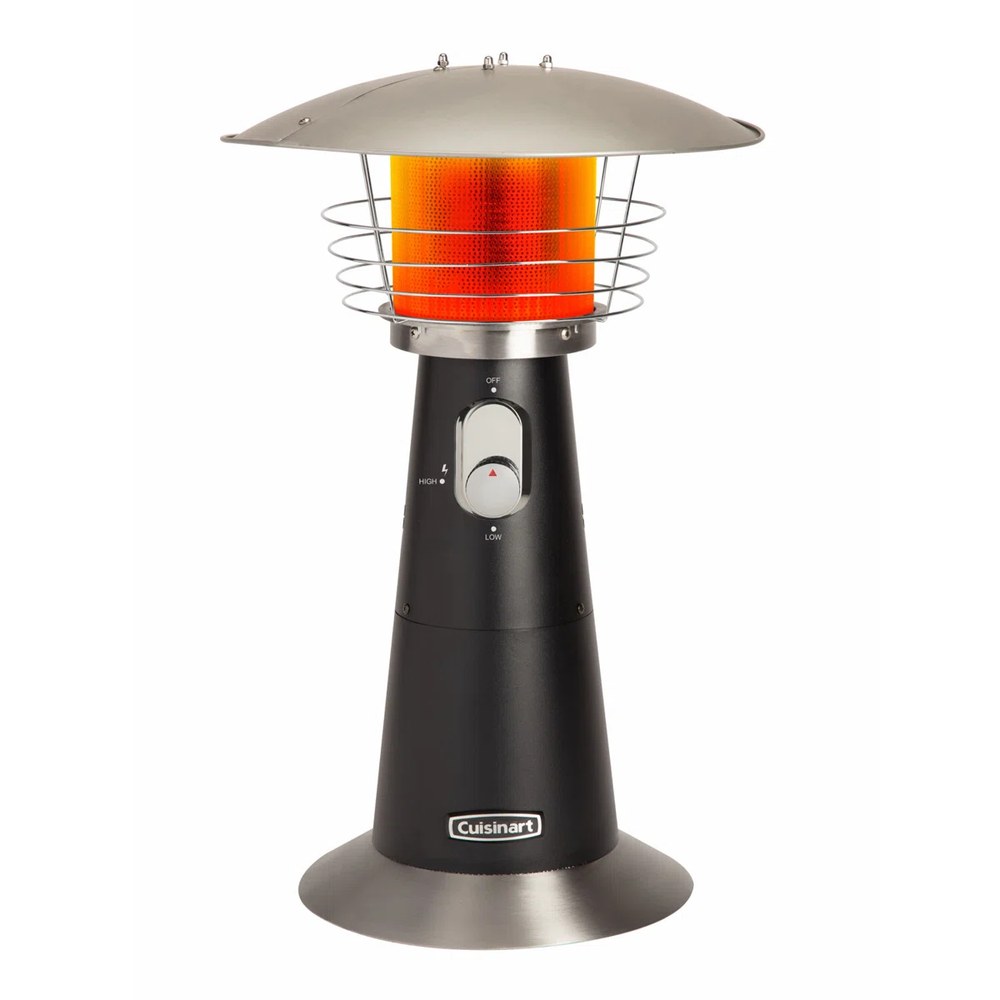
Black Tabletop Heater
- Black & Brushed Steel
$130 per event day + propane per filled tank
Rent This ModelTriangle (Pyramid) Heater Rentals
Glass-tube flame columns that heat the aisle and the entrance while the visible flame does half the décor’s job.
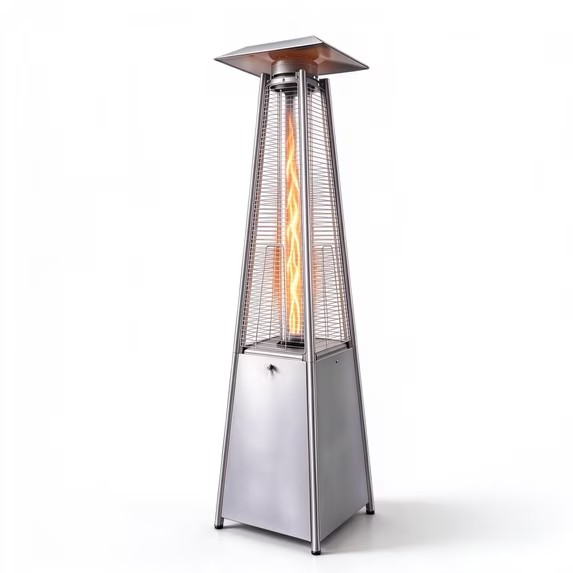
Stainless Pyramid Heater
- Stainless Steel
$130 per event day + propane per filled tank
Rent This ModelWhich heaters we set for a business event
Mushroom heaters carry the floor plan. At 50,000 BTU each, one stainless, bronze or matte-black unit holds a high-top of six to eight or 100–150 square feet of mingling space, which is most of what a mixer looks like. Where a venue bans open flame on an upper balcony or in a soffit, we do not sell you a workaround we cannot deliver — we mark that zone flame-free on the map and heat every terrace, courtyard and rail-side area where flame is allowed.
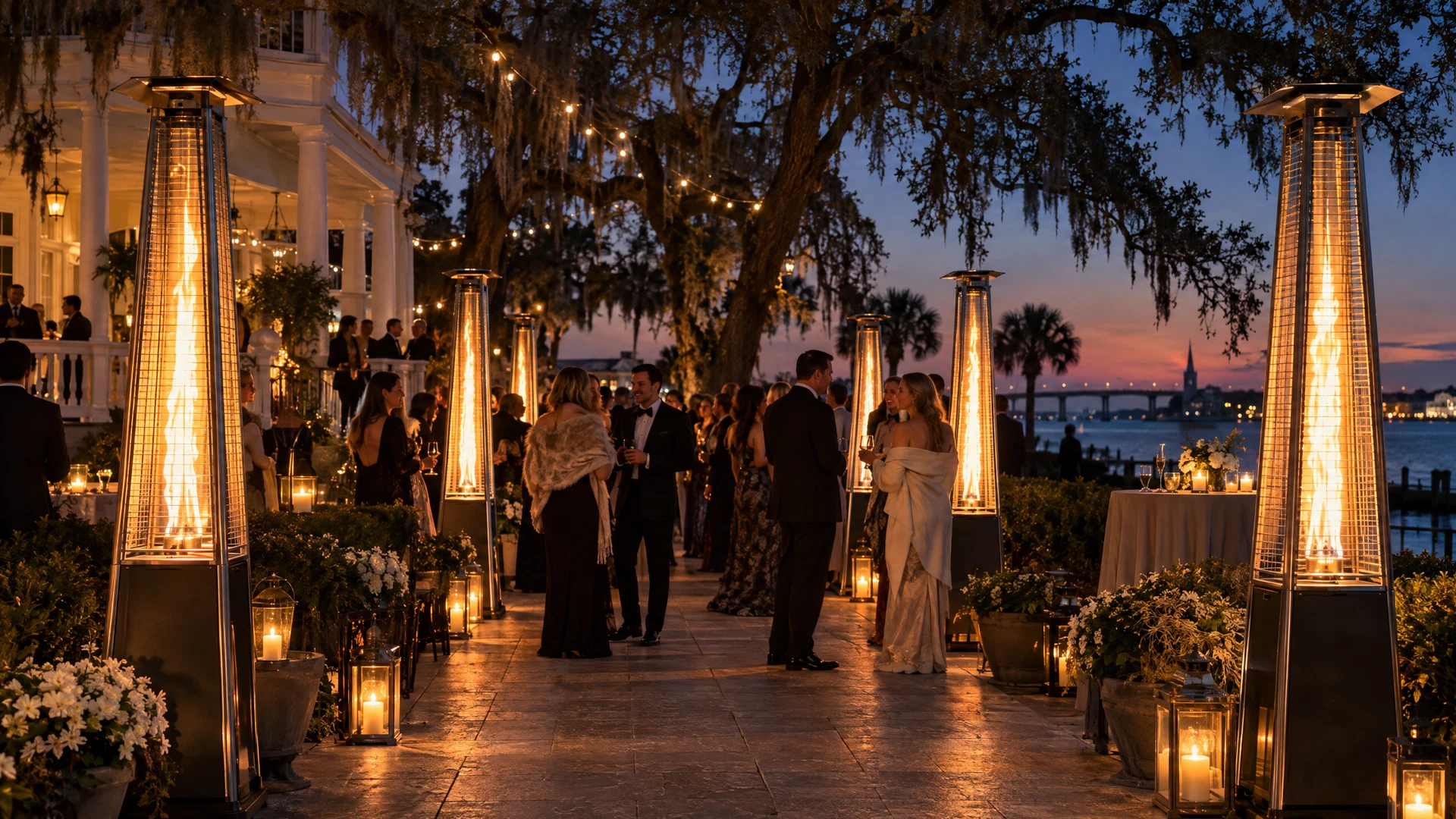
Pyramids earn their place at the branded moments: step-and-repeat, stage edges, the terrace parapet behind the podium, where a visible 55,000 BTU flame reads as production design. The sign-in desk and the food line get a mushroom at the head of the queue rather than a small unit that quits by the second tray. Fully enclosed meeting tents are outside our open-flame fleet — we'll be honest about that and still warm every open-sided zone around them, including the lounge corners, where a pyramid pair does the work.
Sizing zone by zone
Standing events are denser than seated ones. Guests move, so they leave a reflector's view constantly; we count coverage per square foot and per queue rather than per table. Then we add for exposure: rooftops catch the wind even when the street does not, and anything overlooking the Cooper or the harbor gets a multiplier rather than optimism.
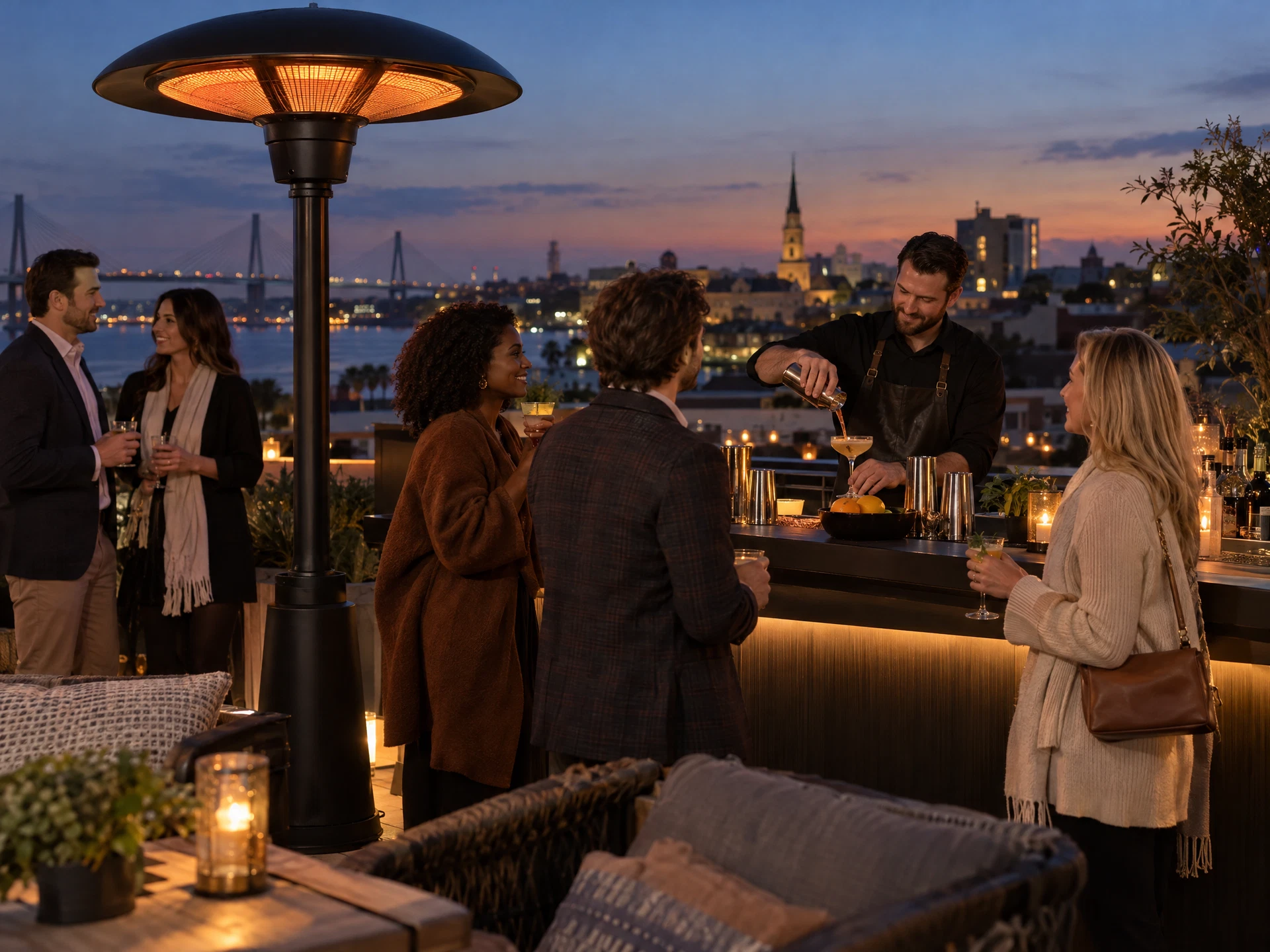
- Rooftop mixer, 90 guests: eight mushrooms along the railing and bar, a pyramid pair at each lounge corner
- Courtyard cocktail hour, 60 standing: five units at 100–150 sq ft each, plus one at the sign-in desk
- Holiday floor party in an open-sided marquee, 80 seated: eight mushrooms on the tables, four pyramids on the perimeter
- Product launch patio, 120 mixed: six mushrooms at the rails and bars, two pyramids at the step-and-repeat
- Retreat lawn, 40 people around a seating circle: a fire pit table at the center, a pyramid pair beside it, four mushrooms backing the seating arcs
Placement that survives a floor plan and a fire marshal
Corporate layouts move late — a bar gets added, a registration desk migrates, a sponsor wants the corner. We build placement around fixed constraints first: 36 inches from anything combustible, clear egress paths, no unit chained across a walkway, and bases never parked on a cable run. Everything else flexes with the plan, and we will re-place on site if your layout shifts before doors.
On rooftops the discipline matters more: nothing sits against a parapet that could transfer heat to a membrane, cylinders are staged clear of egress and carried up before doors, and every position is checked against the venue's flame rules with your facilities contact in advance. You get that on paper with the quote — which is usually the document your insurance or venue manager asks for.
Timing that fits a run-of-show
Doors at 6 means lit and leak-checked by 5:15, which means delivery in the 7am–7pm service window the day before or early that afternoon. For a keynote or presentation we drop output to medium during the talk — radiant heat does not compete with a speaker, and low flame flicker stops catching stage lighting — then back to high for the reception immediately after.
For multi-day retreats, scheduled mid-event tank swaps keep the fleet honest without a technician walking the room. Sunday service runs 9am–5pm, so a Saturday-night event can be topped off on-site Sunday morning and picked up on a scheduled after-event window rather than at an awkward hour. For a conference block that runs three evenings on the same lawn, we leave a standing set in place and swap cylinders between sessions instead of rebuilding the floor each morning.
The five questions operations managers ask
These five questions surface on almost every corporate quote, usually from whoever has to approve the invoice, so they are answered here in plain terms rather than left for a week of email between a facilities manager and a venue coordinator. Answering them up front is how a purchase order gets approved the same afternoon instead of next quarter.
- Certification: every unit in the fleet is CSA/UL listed for outdoor use
- Clearances: 36 inches to combustibles, verified and leak-checked at placement
- Liability: delivery, placement, lighting and scheduled pickup are included in the rental
- Noise: every unit we rent is radiant and silent — no blowers anywhere in the fleet
- Tents: fully enclosed canvas gets no open flame from us, no exceptions; we heat every open-sided zone
Booking timeline and how it gets approved
December is our peak: holiday floors, year-end mixers and galas all land on the same six weekends, so book 2–4 weeks ahead for a Friday or Saturday. January and February Thursdays are usually still open inside a week, and same-week fills happen when a venue unexpectedly clears its calendar. The date we cannot usually rescue late is a Friday in the second half of December, when three events are already sharing one truck.
Events at 12 or more units get a free walkthrough with your facilities or venue contact, and the quote arrives with the placement map already drawn — which is the fastest way to get a purchase order approved internally. Final zone counts confirm 72 hours ahead, and a zone that dissolves — a bar moved indoors, a stage struck early — frees units we redeploy without touching your total.
Best for
- Rooftop and terrace mixers with evening wind exposure
- Launch patios and step-and-repeat arrivals that need to photograph
- Multi-day offsites needing scheduled tank swaps
Watch out
- Upper balconies that ban open flame stay flame-free on our map — we confirm the rule first
- Rooftop gusts strip warmth fast — plan the wind multiplier, not the hope
- Price is $130 flat per heater, per event day; propane billed per filled tank used
The corporate fleet, piece by piece
What to ask for by zone, and where to read the specs.
Book the heaters, keep the rooftop busy
Tell us your date, layout and guest count — the placement plan and quote come back the same business day.
Business events, warmed on a schedule
Frequently asked questions
How many heaters does a rooftop mixer need?
Count the standing area, not the invite list. At 100–150 square feet per mushroom, a 1,200-square-foot rooftop with a bar and two lounge corners lands around eight to ten units. If the roof faces the water, we pair units eight feet apart on the windward edge, which usually adds two more.
Can we heat an enclosed tent for a meeting or dinner?
Not inside it. Fully enclosed tents are outside our open-flame fleet — every heater we rent is open-flame propane — column, glass tube or fire pit table — and we will not put one under sealed canvas. We'll be honest about that and still warm every open-sided zone: the registration lawn, the cocktail marquee with the flaps up, the terrace outside the conference room.
Do the heaters need anything from our power supply?
Nothing at all. The whole fleet is propane, so no unit we place needs a circuit, a panel check or an extension cord across a walkway — which is why rooftop and historic-venue builds go so smoothly. What we do confirm in advance with your facilities contact is where cylinders can be staged and swapped without crossing an egress path.
Will heaters be running during a presentation?
At medium, and placed out of the sightline of stage lighting. Every unit in our fleet is radiant, so there is no blower and no fan noise anywhere near a microphone — a talk can run with the whole lawn heated and the audio untouched. We drop the flame further during slides and bring it back up the moment the reception starts.
What is the latest you can book a December event?
Two weeks before a Friday or Saturday is usually workable and we have done shorter. December weekends are our tightest stretch of the year, so once the fleet is committed we cannot promise units — a same-week conversation is always worth having, especially for midweek dates.
From the people who run the calendar
“Our rooftop held its full layout in January for the first time. The placement map made it easy to get facilities to sign off.”
“They lit everything before our first guest arrived and were gone before the keynote. That is the whole job, done right.”
“Two tank swaps across a six-hour retreat and nobody in the room ever saw a technician. Guests just stayed warm.”